
Sound Healing
Immerse yourself in sound, let the frequencies and vibration take you on your own healing journey.
We can all relate to hearing a sound that has made us feel better for hearing it. Be it a bird, the wind in the trees, the waves crashing on the beach, voices singing in harmony, a musical instrument being played, or hearing our favourite song. Sound is one of our key senses and our bodies respond to it in more ways than we might understand at first.
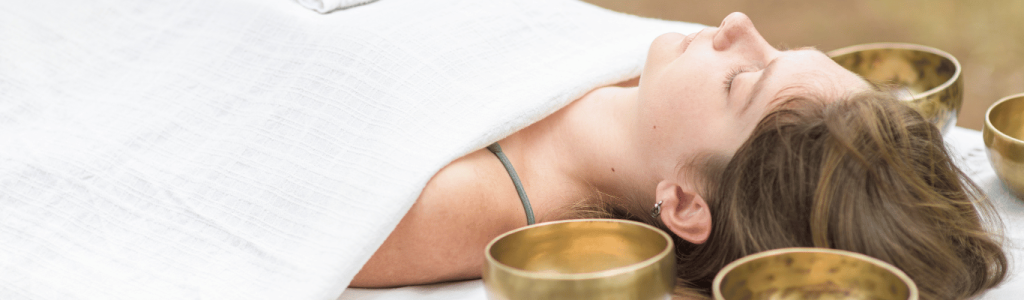
What is Sound Healing and
How can it Benefit Me?
Sound healing or sound therapy, sound baths, sound massage, gong baths, sound meditation, sound journey and lots more, all use sound and vibration to stimulate physical and emotional wellbeing.
The fundamental principle of sound healing is grounded in the understanding that everything in the universe is in a constant state of vibration, including our bodies.
Let’s take it back to basics; sound is produced when an object vibrates, so sound is energy made by vibrations. When we hear something, we are sensing the vibrations that are being transmitted. This vibration is releasing sound even if we can’t hear it. The sound being emitted travels as a wave into our ears to our brain and affects all parts of us, our heart rate, nervous system and every cell in our body. All organs within the body vibrate at their own natural frequency, when a part of the body is out of balance, or not feeling quite right, it may need a retune!
Sound frequencies can resonate with different parts of the body, restoring balance and harmony. Sound frequencies are already being used in medicine today to help reduce pain for those with arthritis, postoperative and menstrual pain. Even medical ultrasound uses vibrations, waves and echoes to produce images of structures within the body. Many benefits of sound healing are supported by scientific research, the growing research suggests that meditative music and sound frequencies can help ease anxiety and reduce pain as well as improve a magnitude of other issues associated with physical and mental health.
Some of these reported benefits include; reduced blood pressure, reduced cholesterol, reduced risk of heart disease, reduced chronic pain, increased energy levels, balances chakras and releases blocked energy, relief from headaches, improves sleep, reduced anxiety, reduced stress, regulates mood, stimulates the parasympathetic nervous system helping the body’s organs rest, heal and regenerate.
Sound Healing sessions involve listening to specific tones, vibrations, or music, as well as instruments such as singing bowls, gongs or tuning forks to stimulate physical and emotional wellbeing. The sound vibrations from singing bowls, gongs, and other instruments, allow for deep relaxation of both of the brain hemispheres and help relieve stress and release toxins from the body.
The human body is in average 60% water which is an excellent conductive medium for sound and vibration…
Ultimately, sound healing supports our physical, mental, emotional and spiritual wellbeing.
What Happens in a Sound Session?
The most important thing to note when beginning a sound healing journey is that everyone’s experience is unique. One day you may have an emotional breakthrough, another you may feel blissfully relaxed and even go to sleep, or it could evoke an emotion for release. The best thing to do is have no expectations, relax and let the experience take you on your journey. Trust that you will receive exactly what you need on the day. There will be an initial consultation to discuss any particular concerns or requirements. You will then lie fully clothed on the floor with a mat, blanket and pillow, you can bring along anything that makes you feel cosy, even your pj’s! Sitting on a chair is also an option if this is more comfortable for you. Most of the time, you will be guided to relax and let go by a spoken meditation, sound healing or therapy will start shortly after. I work intuitively primarily with Tibetan singing bowls, gong and chimes.
Some sound healing instruments can be applied to the body, this would only be in a 1-1 sound therapy session after an initial consultation. This can be an incredible experience where you are fully immersed in the sound and vibration flowing through your body. This can be particularly beneficial if you have a specific area of concern to work on. Please note this is not suitable for everyone.
Sound healing can help people who struggle with traditional meditation by giving the conscious mind something to focus on. Equally, you don’t have to listen or pay attention to the sounds or vibrations, just know they are doing their job, travelling through your body whilst you are relaxing. The vibrations will still be working for 24-48 hours after the session.
“If we accept that sound is vibration and we know that vibration touches every part of our physical being, then we understand that sound is heard not only through our ears but through every cell in our bodies.” – Dr Mitchell Gaynor
Who is Sound Healing for?
Sound healing is for just about anyone and can be used as a self care practice to promote healing and relaxation in the mind and body. Even if you feel perfectly fine, you and your body will thank you for the time you have allowed yourself for some ‘you time’!
There are however some contraindications: – Not suitable for people with pacemakers or any implanted electrical device. Not suitable for anyone who may suffer from sound induced epilepsy, acute mental health conditions or a serious heart condition. Not suitable for ladies during the first 12 weeks of pregnancy.
Sound healing is a complimentary therapy and should not be used as a substitute for conventional medicine. If you are in any doubt, please consult your own GP before attending.
Animal Sound Healing

Just like humans, animals are very receptive to sound and vibration, if not more so than humans! A cat’s purr is a sound frequency that not only helps them heal themselves, but have been shown to aid in the healing of broken bones, joints and tendon repair in humans too.
The same principles of sound healing apply to animals but they decide how long they need and generally which frequency they prefer. All animals are different and will respond in their own way.
Imbalances can be the causes of disease and illnesses in animals and humans alike. It’s also worth remembering that when we as owners are out of balance, it can affect our pets too.
All animals can benefit from sound healing, including those with anxiety and animals who have reactions to loud noises. The vibrations or sounds can be used to help dissolve blockages, release areas of stagnant energy, revitalise the organs, re-energise the aura and physical body and bring peace and harmony, deep relaxation and sleep.
Many studies by sound healers and pet owners attest to the positive calming effects of sound treatments on their animals. They have reported that sound treatments seem to reduce stress and pain, and create vitality and spontaneous healing.
Let me share a story about one of my Maine Coon cats, Mia. I have always been an animal lover and couldn’t wait to have a Maine Coon, the largest domestic cat breed in the world. By the age of 2, Mia had 4 major hip surgeries and more drugs and tests than a pharmacy! She had always been unique, especially with her behaviour, but this had explained a lot. She has a big personality and a loud voice, but she has guided me on the journey of animal healing.
Mia is now 8, she has always been incredibly sensitive to foods and environments but often due to intolerances. She has had other operations, including for being allergic to her own hair follicle! Mia has also enjoyed acupuncture (surprisingly), homeopathic remedies and sound healing, she also loves crystals. It was a big surprise how much she enjoys singing bowls and more so that she regularly asks me to play them. I have learnt so much along the way, including that she responds very well to alternative therapy and better still she loves it!
Animal sound healing would take place in your own environment, or a suitable location for them. Please contact me to discuss your pet’s requirements Holistic or complimentary therapies such as energy or sound healing, should not replace conventional medical care provided by your vet. No outcome of healing can be predicted, promised or implied. If in any doubt about your animals’ wellbeing, please contact your vet.
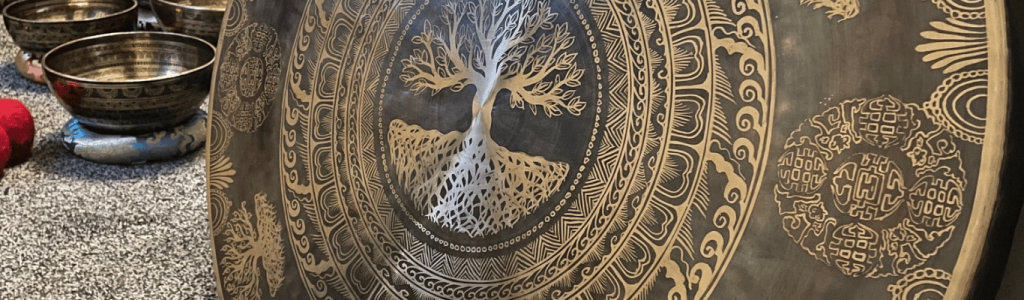
Sound Healing - Past, Present and Future
Sound healing is an ancient practice that has been used for thousands of years across many parts of the world. Sound healing has been used to realign the body’s vibration, improve mental health and emotional wellbeing, and even ward off evil spirits. For many years, sound has been used as a sacred instrument for healing and for spiritual development. The earliest recorded traditions date back thousands of years where evidence suggests that the Aboriginal people of Australia used the didgeridoo for at least 40,000 years as a sound healing tool for humans and animals, to heal broken bones, muscle tears, and a wide range of other illnesses.
In Asia, when Shintoism and Tibetan Buddhism became popular, gongs and singing bowls were considered sacred and were mandatory at religious ceremonies to enable monks to achieve that meditative state of inner peace.
In Egypt, references to music for healing are found in their ancient papyrus texts. They describe chant like incantations for healing the sick and used an instrument that generated an ultrasound for healing. Entire structures were built to maximise the therapeutic effects of sounds during ceremonies. The acoustician, John Stuart Reid, claimed that the Kings chamber within the Great Pyramid of Giza, was created in a way that sound vibrations were maximised to amplify the power from chants, and claims his chronic back pain was cured while experimenting with sound inside the pyramid.
In Greece, sound healing was used to cure mental disorders and used vibration to help with digestive problems and assist with sleep. Aristotle mentioned that flute music could stir up intense emotions and purify the soul. Pythagoras, another Greek philosopher, discovered the beauty of harmonic intervals and used specific melodies to treat psychological disorders.
In South America the Mayan shamans considered the flute as sacred and used for shamanic rituals and healing.
Christianity embraced sound as part of its tradition with Churches and Cathedrals designed to create an acoustic opportunity to enhance the singing and chanting to a more spiritual level. Not to mention the bells being thought to have healing powers.
In the 1930’s, acoustic researchers discovered ultrasound and its medical properties. In the 1940’s, the research of Dr Alfred A Tomatis led to the development of the Tomatis method, which used sound therapy to treat a variety of disorders.
Sound healing as a scientific and medical practice in the Western world was pioneered by English osteopath Sir Peter Guy Manners. In the 1960’s his research focused on using audible voice frequency in several different treatments. He believed his sound healing methods stimulated the human body’s natural healing abilities. He used these methods to study and treat chronic inflammation, arthritis, and bone calcification. By the 1990’s, Manners had developed the first computerised system to treat a range of conditions. This was followed by Dr Alfred Tomatis, and Guy Berard who created auditory integration therapy designed to improve a range of issues including anxiety and learning disabilities.
In the late 20th century, Fabien Maman, a French musician, acupuncturist, composer and bioenergetic researcher, discovered the use of tuning forks in sound therapy. Tuning forks are now used in sound healing and can communicate vibrations to the body, DNA cells and magnetic field. More recent studies are focussing on how chemicals are produced in the reward centres of the brain when listening to music or sounds.
As scientists continue to study the relationship between sound and the body and mind, they are rediscovering sacred knowledge. The emergence of sound as a holistic or complimentary therapy highlights the importance of sound as a significant healing and transformational tool for the 21st century and beyond.